Free Patient Resource
Is Scrambler Therapy right for you?
A plain-English guide to help you decide whether to explore Scrambler Therapy for chronic or neuropathic pain — what it actually is, the only two authentic devices, the questions to ask before you book, and how to find a qualified provider.
01 — Introduction
What is Scrambler Therapy?
Scrambler Therapy® — also known as Calmare® Therapy — is a non-invasive, drug-free treatment for chronic and neuropathic pain. It was invented by Professor Giuseppe Marineo in Italy and uses small surface electrodes (similar to EKG pads) placed on the skin near the area of pain.
Instead of blocking or numbing pain signals, the device sends carefully shaped electrical signals through the same nerves that are transmitting pain. The brain receives these new signals as "non-pain" information. Over a series of sessions, the goal is to retrain the nervous system so that it stops interpreting those signals as pain.
A typical course is roughly 10 consecutive weekday sessions, each about 30–45 minutes. Many patients report meaningful relief during or shortly after treatment, though results vary by condition, provider, and protocol.
02 — What it treats
Conditions commonly treated
Scrambler Therapy is most often used for chronic and neuropathic pain conditions that have not responded well to medications or other conventional treatments. Reported uses include:
- Chemotherapy-induced peripheral neuropathy (CIPN)
- Diabetic peripheral neuropathy
- Postherpetic neuralgia (pain after shingles)
- Complex regional pain syndrome (CRPS / RSD)
- Failed back surgery syndrome and chronic low back pain
- Sciatica and other radiculopathies
- Phantom limb pain
- Post-surgical and post-traumatic neuropathic pain
- Migraines and Headaches
- Trigeminal neuralgia and certain facial pain syndromes
- Fibromyalgia-related pain
- Pudendal neuralgia and select pelvic pain conditions
Results vary by condition, provider, and protocol. Scrambler Therapy is not a guaranteed cure, and not every condition or every patient will respond. A qualified provider should review your diagnosis and history to discuss whether it's a reasonable option for you.
03 — The technology
The two authentic Scrambler Therapy devices
There are only two genuine sources of Scrambler Therapy technology in the United States. Both deliver the same underlying technology originally developed by Professor Marineo. The outer casing and controls look a little different, but the core waveform is the same. If a clinic is using anything else — a TENS unit, an "advanced" muscle stimulator, or an unbranded knock-off — it is not genuine Scrambler Therapy.
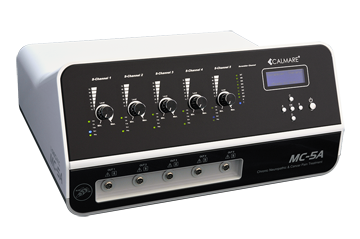
Calmare® MC-5A
Distributed in the U.S. by Calmare Therapeutics.
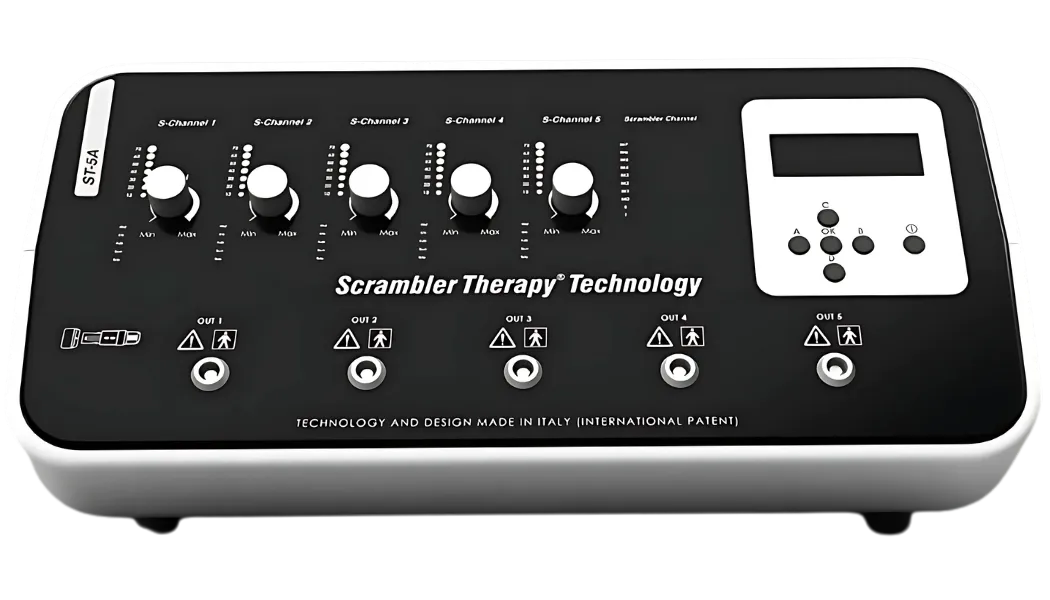
Scrambler Therapy™ ST-5A
Distributed by Delta Research & Development (Italy).
Because the two distributors operate independently, each runs its own training and there is no universal standard of care or accreditation body governing how providers are taught. That means the device matters, the protocol matters, and — maybe most of all — the provider matters.
04 — Before you book
Top questions to ask a provider
Because there is no single curriculum or governing body, two clinics legitimately offering "Scrambler Therapy" can deliver very different experiences. These questions will quickly tell you how committed and experienced a provider really is:
- How many patients have you treated with Scrambler Therapy?
- Do you have a supervising physician and if so, who is this person?
- Who will actually be administering my treatment?
- Where and from whom did you receive your training?
- Is Scrambler Therapy a primary focus of your practice, or one of many services you offer?
- What does your treatment protocol look like, and how did you arrive at it?
- How do you measure and track patient outcomes?
- Which device do you use — Calmare MC-5A or Scrambler Therapy ST-5A?
- How much do you charge per session and are there any other therapies or modalities included in the cost?
- How long is each session?
The depth and confidence of the answers tells you a great deal about the level of expertise you can expect.
05 — Safety
Contraindications & who should not receive it
Scrambler Therapy is generally considered very safe and well-tolerated, but it is not appropriate for everyone. Talk with your physician and the provider before starting treatment if any of the following apply:
- You have an implanted electrical device (pacemaker, defibrillator, spinal cord stimulator, deep brain stimulator, or implanted insulin pump).
- You are pregnant.
- You have a history of epilepsy or uncontrolled seizures.
- You have skin lesions, open wounds, active infection, or severe dermatitis at the electrode placement sites.
- You have a known allergy to the adhesive used in surface electrodes.
- You have a history of serious cardiac arrhythmia or other unstable cardiac condition.
- Patients using neuroleptic agents for pain should work with their prescribing physicians to wean off these medications prior to treatment to obtain the most significant outcome possible.
A qualified provider will screen you for these and other factors before your first session. If they don't, that itself is a warning sign.
06 — Next step
How to find a provider
Because experience and protocol vary so much from clinic to clinic, finding the right provider is the single most important decision you'll make. We've built a free, searchable map of Scrambler Therapy providers to make that easier.
When you contact a provider, bring the questions from section 3 with you. A great provider will welcome them.
07 — Important
Disclaimer
This guide is for general informational purposes only. This resource is not intended to diagnose, treat, cure, or prevent any disease or medical condition, and is not a substitute for — or alternative to — information and care from a licensed healthcare professional.
Please consult your healthcare provider about your specific condition, potential interactions, and any possible complications before starting Scrambler Therapy or any other treatment.